- What it isSoC integration and IP assembly
- InputsIP-XACT, Verilog, VHDL, SV interfaces, XLS/CSV
- Scripting200+ Tcl commands, Java API
- LicenseFree, no license server
Overview
Modern SoC and FPGA projects assemble hundreds of IP blocks from internal teams, other divisions and commercial IP vendors, across multiple power and voltage domains. IP integration is where that effort and most of the connectivity errors concentrate: thousands of ports wired by hand, and re-wired every time the constraints change.
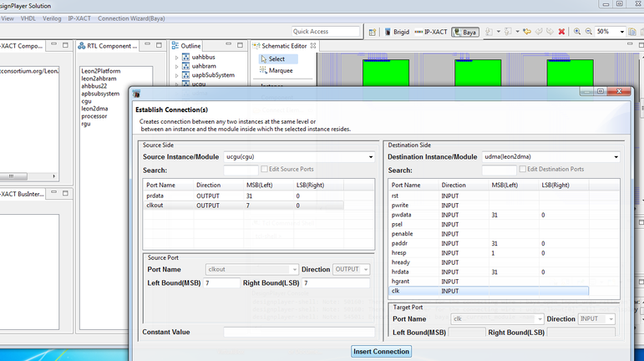
Baya is a free SoC integration tool for IP assembly in VLSI and SoC design. It assembles subsystems and full SoCs from IPs defined in IP-XACT, Verilog or VHDL, auto-connects AXI4, AHB, APB, PCIe, DDR and custom interfaces by rule, manipulates hierarchy, and writes connected RTL. Its GUI provides Commands, Tool Boxes and a Connection Wizard to import IPs, instantiate components and build connections, and every action maps to Tcl: around 200 high-level Tcl commands and hundreds of low-level APIs for advanced users. See the SoC integration guide for methodology and a comparison with commercial integration tools.
Install and run
These commands come from the examples/ directory in the current release and were run against it.
$ curl -fsSL https://edautils.com/install.sh | sh -s -- baya-shell
$ source $EDAUTILS_ROOT/setup_env.sh
$ baya-shell create_design.tcl
with create_design.tcl containing:
baya_set_file -name system1.v
baya_import_verilog_filelist -filelist infile.list -top top
baya_set_current_design -name leaf
baya_create_hierarchy -insts u_grandleaf_1,u_grandleaf_2 \
                      -new_inst_name u_new_grandleaf -new_mod_name new_grandleaf
baya_set_current_design -name top
baya_remove_hierarchy -inst u_mid_1
puts [baya_print_verilog -module top]
Linux and Windows, Java 8 or newer, no license server. Every command accepts -help.
The GUI
Supported standards
| Standard | Versions | Notes |
|---|---|---|
| IP-XACT | IEEE 1685-2009, 1685-2014, 1685-2022 | 1685-2009 is the default output; -v2014 and -v2022 select the newer schemas. SPIRIT 1.4 and 1.5 files are read. |
| Verilog / SystemVerilog | IEEE 1800-2012 grammar; source types 2009, 2012 and 2017 | Covers Verilog-2001 and Verilog-2005 designs. |
| VHDL | VHDL-2002 and VHDL-2008 source types | Entities, architectures, packages and generate statements. |
| UPF | IEEE 1801-2013 | Parser, editor, decompiler and validator (upf-shell). |
RTL partitioning and netlist restructuring
Partitioning is the part of SoC assembly most integration tools hand back to a script. Baya does it on the elaborated data model and then proves the result. baya_create_hierarchy groups a set of instances into a new level, baya_remove_hierarchy ungroups one level or every level beneath it, and both write a change report with every object categorized as renamed, reparented, moved or added.
| Operation | Command | Proved at |
|---|---|---|
| Ungroup one hierarchy level | baya_remove_hierarchy -inst <inst> | 2,246,403-line design, 1,423,734 printed lines, 685 top-level instances after the ungroup |
| Ungroup every level beneath | baya_remove_hierarchy -all_levels | — |
| Group instances into a new level | baya_create_hierarchy -insts <list> -new_inst_name <i> -new_mod_name <m> | the same design, two levels of regroup over the ungrouped result |
| Prove the result kept its connectivity | built-in node-fingerprint equivalence check | ungroup plus two regroups checked equivalent in 2m40s inside an 8 GB heap |
| Report what changed | remove_hierarchy.<inst>.rpt, create_hierarchy.<inst>.rpt, restructure_summary.rpt | — |
The equivalence check is inside the tool rather than a hand-off to a separate logic equivalence checker. It fingerprints every node and compares the multisets, so it is invariant under renaming and re-hierarchy, and it answers the only question a restructure raises: did the connectivity change? Restructuring flows in the shipped regression estate are digest-gated and carry recorded CPU, wall-clock and peak-memory budgets, so a release that changes its output or slows down fails before it ships.
Recent additions
These landed in the September 2026 releases. Each is gated by the regression estate that ships alongside the tool.
September 2026
- IEEE 1685-2022 TGI inside the shell. A
tgi::Tcl namespace inbaya-shellandipxact-shellexposes the IP-XACT Tcl Generator Interface under its standard names and argument order, so generator scripts run in-process against the design already in memory. The 2009 and 2014 spellings are accepted as aliases, and a migration scanner reports which calls in an existing generator survive in 2022. - Whole SoCs rebuilt through TGI. Two reference RISC-V SoCs were reassembled from their IP-XACT, once in Baya Tcl and once through TGI, then compared node for node against the reference top level: 202 and 588 nodes equal.
- verilog2baya round trip. Computed bit expressions, packed multi-dimensional arrays, wide literals and brace-quoted names now survive the conversion, and a net keeps one name across the round trip instead of acquiring a second.
- Modular CSV export.
baya_print_modular_csvwrites one connection CSV per instance, so several teams can own and review their own slice of an integration while the whole SoC stays a single rebuild. - Constraints and power intent alongside the integration.
sdc-shellandupf-shellparse, edit, compare and decompile SDC and UPF against the same data model the integration runs on. - Unix-like hierarchy browsing.
set_root,ls,cd,pwd,mkdir,rmandrenameoperate on the design hierarchy, through generate blocks, instance arrays and escaped identifiers. - Faster on large designs. Declaration, port and port-id lookups are indexed, two quadratic loops are gone from the integration engine, and a memory-aware scheduler runs the estate inside recorded budgets.
- SystemC emitter rebuilt.
verilog2systemcandvhdl2systemcwere audited end to end and their output builds clean as C++.
Salient Features of Baya
- 200+ high level Tcl commands for SoC platform assembly
- Easy to get started - use verilog2baya tool to convert existing SoC/SS into Baya format
- Supports Adhoc and Interface based connections
- Supports Autoconnections with rule-based connections between component ports
- Maintains a connectivity database with advance queries
- Supports multiple SoC integration methodologies: XLS/CSV based connections, Port-to-Port adhoc connections, IP-XACT and SystemVerilog Interface based connections
- Hierarchy Manipulation to create Power Domain, Voltage Domain, comply with floor planning
- Associate IP-XACT memory maps with SoC component instances to dump C Model for entire design
- Glue-Logic insertion support
- Spare port insertion through hierarchies
- Automatic creation of top module and ports based on specified rules
- Creates empty modules for compile and elaborate checking
- Utility to compare Entities, Modules and IP-XACT Components
- IP-XACT Coherency checker to ensure compliance with RTL
- Tcl commands to save database as VHDL, Verilog and IP-XACT Design
- Reports Design Maturity in terms of % of unconnected ports
- Unix-like commands (ls, cd, rename etc.) to browse design
- Powerful GUI with hierarchical views and drag-drop capabilities
- RTL partitioning: group, ungroup and regroup hierarchy on a 2M+ line netlist, with a built-in connectivity equivalence proof rather than a hand-off to a separate equivalence checker
- IEEE 1685-2022 TGI: standard IP-XACT generator calls available as a
tgi::Tcl namespace inside the shell, with 2009 and 2014 spellings aliased - Every capability scriptable headless, so an AI agent or a CI job can install, run and check the flow without a GUI
- Source code available on demand under a separate agreement
Demo & Tutorials
Customer Testimonials
"The collection of tools and utilities fills a real void in EDA. The baya tool is exactly what we had been looking for to assemble large top-level modules in Verilog. The GUI and high-level TCL commands are intuitive, allowing designers to get started immediately and feel right at home. It was straightforward to quickly reproduce a module previously done with a Perl-to-Verilog utility that was hard to use and maintain. The support from Kanai is excellent. He responds quickly and is a pleasure to deal with. Nice work, Kanai!"
"Thanks for efficient tools which have been successfully used in our internal wireless design flow. Friendly support has been highly appreciated."
"Baya is a mature production quality tool with features and capabilities beyond those of tools provided by large EDA vendors. It's flexibility is a key reason we have chosen it for use in our Cloud-based platform."
"Kanai produced an excellent tool set, which is very useful for a complex system-on-chip integration flows. We were skeptical in the beginning, but later got really impressed by a high quality and ease of use. Bridgit IPXACT creator helps us to pack register, bus and module interfaces into a IEEE standard *.xml SPIRIT format to ensure high reusability in the future and protect our investments. I highly recommend using Kanai's products for every system-on-chip manufacturer."
Frequently asked questions
baya_create_hierarchy groups instances into a new hierarchy level and baya_remove_hierarchy ungroups one level or every level beneath it, on the elaborated data model rather than by editing text. Both write a change report categorizing every object as renamed, reparented, moved or added, and a built-in node-fingerprint equivalence check proves the connectivity did not change. Measured on a 2,246,403-line design: ungroup plus two levels of regroup, checked equivalent in 2m40s inside an 8 GB heap.tgi:: namespace inside baya-shell and ipxact-shell, under the standard call names and argument order. The 2009 and 2014 spellings are accepted as aliases, and a migration scanner reports which calls in an existing generator survive in 2022.curl -fsSL https://edautils.com/install.sh | sh -s -- baya-shell, discovers switches with baya-shell -help, and runs a whole flow from one Tcl script. No GUI, no license server, no interactive step.SoC Integration Utilities
Each of these ships as a standalone command as well as a Baya Tcl command.
- createhierarchyGroup instances into a new hierarchy
- removehierarchyUngroup and dissolve hierarchy levels
- Verilog FlattenerFlatten instances or a whole design
- Find Instances or NetsSearch instances and nets across hierarchy
- Remove AssignmentsStrip concurrent assignments from a netlist
- Clock & Reset Tree AnalyzerTrace clock and reset trees